
#8: It's heating up
A deep dive on the new heat stress advisory.
Singapore recently launched a new heat stress advisory.
It is no secret that Singaporeans are experiencing increasingly hot and humid weather. In fact, the high humidity in Singapore - averaging 83.9% - can make it feel hotter than the actual temperature! Our body naturally cools down when our sweat evaporates from our skin. But humid air has high moisture content and slows down the evaporation of our sweat, hence the greater heating effect.
2013 to 2022 was the hottest decade yet in Singapore, and recently, on the 13th of May, we experienced the hottest day in the past 40 years, with a record temperature of 37 degrees Celsius.
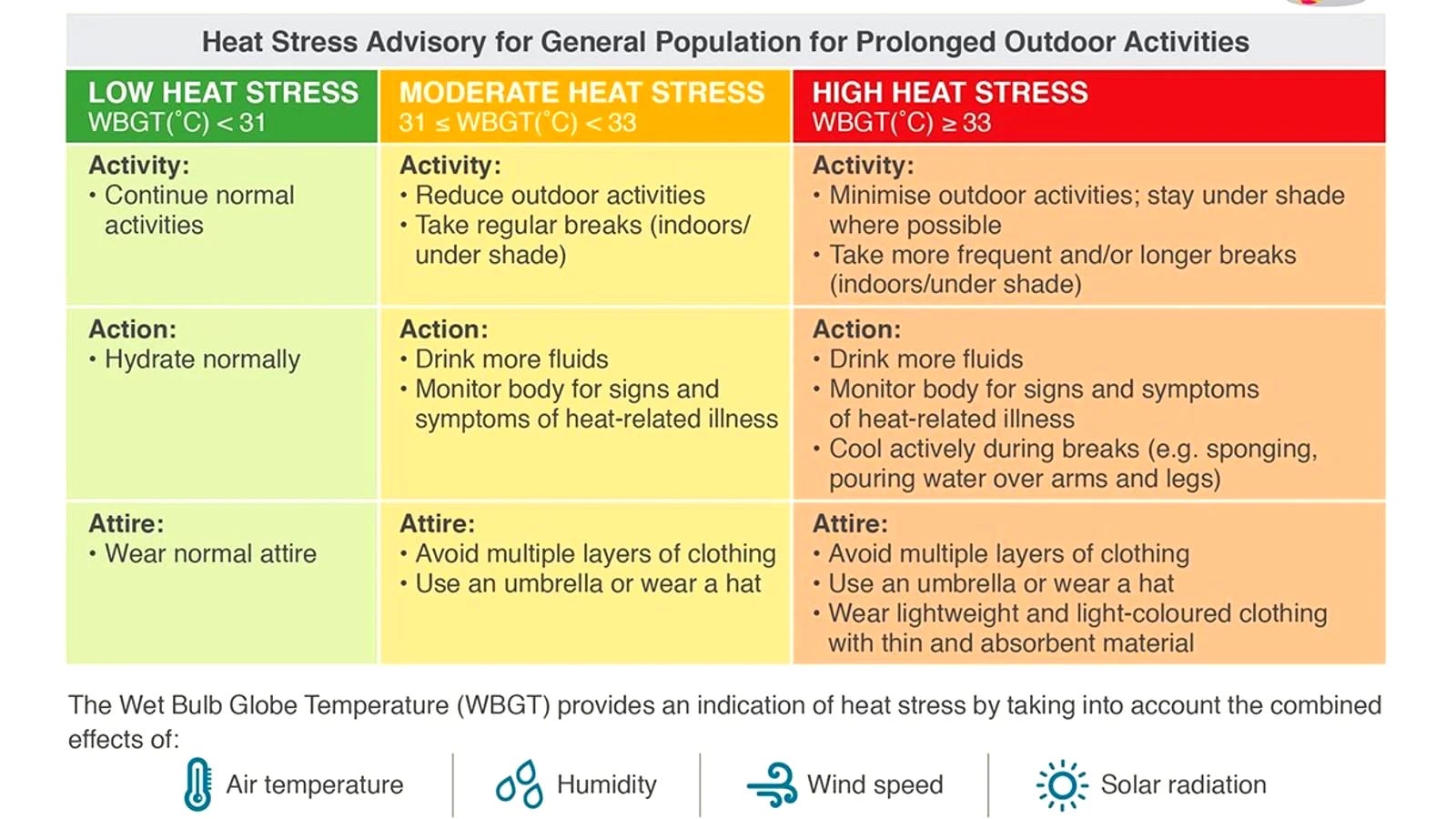
In response to rising temperatures, the MSE and NEA released a new heat stress advisory that would help the general public minimise heat stress and heat-related illness. The pamphlet outlines three heat levels: low, moderate, and high levels of heat stress, and details the subsequent precautions one should generally take. In addition to general suggestions, the pamphlet emphasises more vulnerable groups like the elderly, children and pregnant women take further precautions.
The impacts of heat are not evenly distributed.
Crucially, vulnerability to heat depends on factors such as health, disabilities, illness, gender, age, and social class. Often, the most vulnerable populations are people who face an overlap of factors. For example, elderly populations with disabilities or medical conditions face a far lesser ability to adapt to rising temperatures. Furthermore, larger living areas that create better-ventilated homes and air conditioning often help alleviate heat stress. However, people from lower socioeconomic backgrounds cannot access such facilities.
Workers that perform outdoor manual labour also face higher risks of heat stress. To date, the Migrant Worker Death Map has recorded two migrant worker deaths due to heat stroke.
Meanwhile, only about 25% of low-income households and those living in one- and two-room public flats have air-conditioning, as compared to 99% of private condominiums.
Similar to the spectrum of vulnerability, different responses to heatwaves take on a spectrum of severity. Minor responses like heat syncope include heat rashes, prickly feelings in extremities, and heat cramps, to more severe reactions like heat exhaustion and, most severely, heat stroke. Vulnerable groups are more frequently exposed to more severe heat illnesses and require better adaptation support to remain cool in the hot weather.
The impacts of heat are not always visible. Vulnerable populations might have to refrain from participating in fun outdoor activities with friends! Therefore, while we all bear the brunt of heat discomfort, we should also be mindful and respectful of other people’s limits, and remind friends to take good care of themselves amid the hot weather.
We’ve entered an era of “global boiling”.
Singapore is not the only country heating up rapidly. On the 16th of July, temperatures rose beyond 50 degrees Celsius in Death Valley, US, and in Northwest China. The first week of July itself was the hottest week the world has ever experienced. Most recently, devastating wildfires in Lahaina, Hawaii left 93 dead, with experts pointing to climate-linked drought, global warming, and winds from the passing Hurricane Dora as intensifying factors. Heatwaves are growing in both frequency and intensity worldwide.
“The era of global warming has ended; the era of global boiling has arrived,” United Nations Secretary-General António Guterres said in July.
As heat-related illnesses and fatalities continue to rise—causing over 5 million deaths per annum at present—how should we respond? And how can we better accommodate different vulnerabilities into our adaptation measures?
Coping with extreme heat
The basic essentials: eat nutritious food, hydrate (with both water and isotonic drinks), and take shelter from the heat during outdoor activities. Feel free to drink iced slushies to lower your body temperature during really hot periods!
Ensure that you bring a hat, sunglasses, and umbrellas if needed to protect yourself from the sun’s glare!
Dress for the occasion! Wear light attire when completing physical activity in the heat and avoid wearing heavy and multiple layers of clothing.
More importantly though, there are things we can do on a broader societal level to mitigate heat impacts. The newly launched heat advisory is a good first step in raising public awareness, but it won’t be enough in the long run. Can we go further in protecting our green spaces, which both offer shade and cool surrounding air temperatures? What about changing the way we build: like using heat-reflective paint, building more green walls, and scaling up district cooling? Or even setting minimum air-con temperatures in malls and offices (which are notoriously freezing)? Air conditioners are a major source of greenhouse gases—but every increase of 1°C can reduce carbon emissions by 10 per cent, and electricity costs even further.
Measures also need to be sensitive to the social disparities mentioned above. For instance, NEA could consider expanding the Climate-Friendly Household Package to include cooling appliances such as fans. (This package provides low-income households with e-vouchers to purchase energy-efficient appliances.) And beyond simply urging employers to adhere to optional guidelines for managing heat stress, we also need to build a culture where migrant workers are not merely seen as disposable, so that they can be afforded sufficient rest and protection.
Ultimately, even the most comprehensive heat strategy can only go so far. In the context of climate change, stronger mitigation policies that limit global warming to 1.5°C might just be the most crucial cooling solution Singapore needs.